About
Also known as vibrissae or tactile hairs, feline whiskers are specialised hairs that are found on either side of the muzzle (sinus hairs or mystacial whiskers), the cheeks, above the eyelid, and the wrists of the foreleg. The whiskers on the muzzle are the longest of the three sets on the face and are placed in well-defined rows.
Vibrissae are two to three times the thickness of ordinary hairs, are considerably longer and are embedded in the tissue of the cat’s upper lip to a depth three times greater than other hairs.
They have a rich supply of nerves and blood vessels. Unlike normal hairs, the whiskers at the side of your cat’s mouth are surrounded by a highly developed sheath of muscle tissue which enables them to move both forward and backward.
Each vibrissae follicle is represented in the sensory cortex of the brain in a very precise way.
What is the purpose of whiskers?
The whiskers provide sensory information about the environment.
- The width of the whiskers is genetically predetermined to be approximately the same width as the body. This helps the cat determine if a narrow passageway is large enough for the cat to fit through. However, the whiskers do not grow longer if a cat puts on weight, which could potentially impact the cat’s sense of width perception.
- As the cat moves in the darkness, he uses his whiskers to find his way around objects. The whiskers can detect slight changes in the air current around the object and the cat can walk around the object.
- Whiskers are an extremely valuable tool for the hunting cat, especially at night acting as a guidance system. They can provide information on the outline of the prey, which enables the cat to bite the prey in exactly the right spot to kill it instantly. A cat with damaged whiskers will often aim the bite in the wrong area, therefore not killing the prey.
- The whiskers provide information about the prey in the cat’s mouth and if it is still alive.
Why do mother cats chew off their kitten’s whiskers?
It’s not uncommon for a mother cat to chew off the whiskers of her kittens. It is thought she does this to stop the kittens from wandering too far and possibly getting into trouble.
Whisker facts
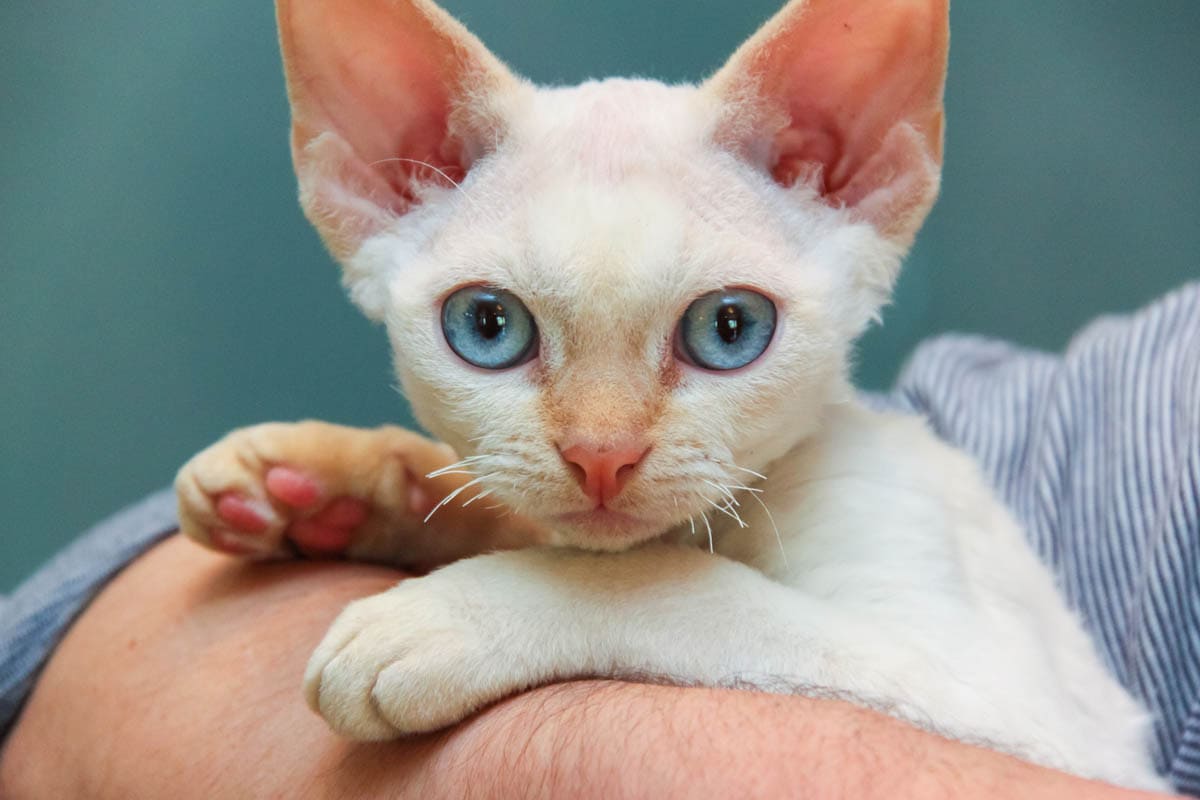
The Devon and Cornish Rex breeds have shortened curly whiskers.
The whiskers behind the wrist on the foreleg are to assist with tree climbing and contact with prey.
Whiskers also give a clue as to your cat’s mood:
- Angry- Pulled tightly back on the face
- Relaxed and happy – Pointing slightly forward and down
- Hunting or aggressive – Forward pointing and tense
Whiskers can be a bit of a nuisance when the cat is eating if the bowl is too narrow as they will touch the sides of the bowl, causing discomfort. Therefore it is a good idea to provide your cat with wide food and water bowls.
Frequently asked questions
Is it okay to cut a cat’s whiskers?
No, cats rely on their whiskers to provide the cat with external information such as the width of a crevice or navigate around objects. There is no need to cut a cat’s whiskers.
Is it normal for whiskers to fall out?
All hairs have a growth cycle and that includes the whiskers although they have a longer growth cycle than other hairs on the body.
Many believe it is good luck to find a whisker.
Do cat whiskers grow back?
Yes, if the whiskers are cut or singed, they will grow back, but it is not a good idea to cut them because they are an important part of the cat’s sensory system.
What are the whiskers above the cat’s eyes called?
Supraorbital whiskers.
Names of other whiskers on the face:
- Genal: Cheeks
- Mandibular: Underside of the jaw
- Carpal: Wrists
Do whiskers have nerves?
The whiskers themselves don’t have nerves, however, there is a rich nerve supply at the base of the whisker, therefore if one is pulled out it will cause the cat pain.
Author
-
by
-