At a glance
|
What is pemphigus?
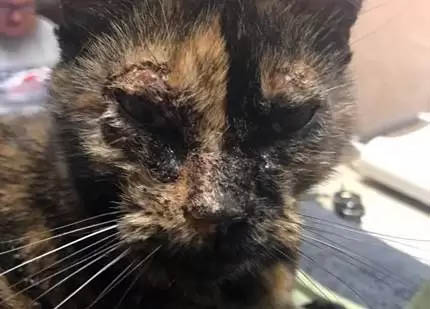
Image Jaimee Cook
Pemphigus complex is a group of rare bullous autoimmune diseases in cats, which are the result of an overactive immune response against the cat’s own tissues. An overproduction of autoantibodies attacks the epidermal bonding molecules causing them to separate, resulting in the formation of superficial vesicles and bullae (a blister that contains serous fluid) which rupture to form crusted erosions on the skin.
Genetic predisposition, exposure to sunlight, certain drugs such as cimetidine and ampicillin, and a history of chronic inflammatory disease are all possible causes.
What we do know is that a separation of keratinocytes (epidermal cell) occurs within the stratum corneum (the outermost layer of the epidermis). Autoantibodies attack the desmosomal proteins which are structures that attach the epidermal cells to each other, which leads to skin cells separating and fluid collecting between the separated layers, known as acantholysis.
Types
The name pemphigus is derived from the Greek word pemphix, meaning bubble or blister. There are three types of pemphigus in cats:
- Pemphigus foliaceus (PF): The most common type, affecting the superficial epidermal layers (the top/outermost layer of the skin).
- Pemphigus erythematosus (PE): The second most common form, affecting the head and feet.
- Pemphigus vulgaris (PV): A rare form of pemphigus producing blisters in the deep layers of the epidermis. Lesions typically occur in the mouth and areas of trauma such as claw folds, ears, armpits, and groin. Secondary infections are common and are often fatal.
Pemphigus can affect cats, dogs, humans, and horses and is the most common autoimmune disease in cats. It affects middle-aged to senior cats most often.
Is pemphigus contagious?
No, it is not possible for cats or people to catch pemphigus as it is an immune disorder.
Symptoms
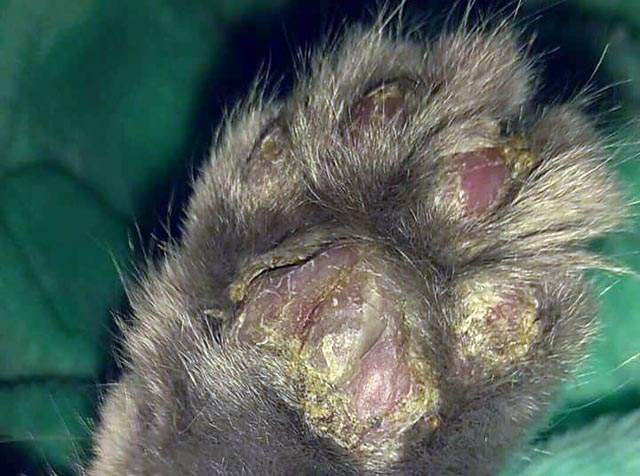
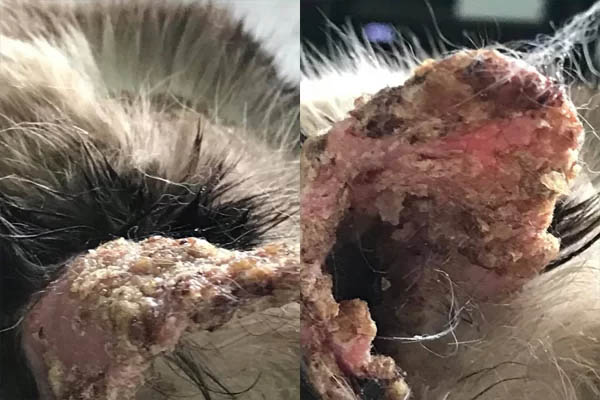
Fluid-filled pustules are the most common symptom of pemphigus. These eventually break open and then form a dry crust. It is also possible for symptoms to wax and wane over time.
P. foliaceus
- The distribution of small red spots and hair loss which develop around the eyes and the bridge of the nose, before spreading to the ears, neck, nail beds, on and around the food-pads, nipples, and groin. Small areas of skin discolouration occur before fluid-filled blisters form beneath the surface of the skin, which rupture, forming a yellowish crusting erosion.
- As the ears become affected, inflammation (otitis externa) can develop.
- Affected areas are painful and itchy.
- Lameness.
- Secondary bacterial infection may also be present.
P. erythematosus
Symptoms are similar to that of pemphigus foliaceus, but milder and only affecting the head and feet.
- Red, inflamed pustules on the head and feet with areas of hair loss.
P. vulgaris
The most severe form of pemphigus with blisters forming in the deep epidermal layers of the skin.
- Affects the mouth, claw folds, ears, armpits (axilla) and groin. These vesicles are easy to rupture and when they do, deep ulcers form.
- Vesicles that are itchy and painful.
- Loss of appetite due to painful ulcers in the mouth.
- Depression.
- Secondary bacterial infection is common with this form of pemphigus.
- Fever due to secondary infection.
Diagnosis
The veterinarian will perform a physical examination of your cat and obtain a medical history from you including how long symptoms have been present, any other medical conditions your cat may have and any medications he is currently taking.
Diagnostic tests are necessary to confirm the diagnosis as symptoms of pemphigus may be similar to that of dermatophytosis (ringworm), demodicosis or paronychia.
- Baseline tests: Biochemical profile, complete blood count, and urinalysis. These can’t diagnose pemphigus, however, they are important to check for concurrent systemic disorders.
- Blister biopsy: A tissue sample is collected by a punch tool to penetrate all the layers of the skin and examined under the microscope. Separated/free-floating detached epidermal cells (acantholytic keratinocytes) will be seen. The biopsy will determine which layer of skin is involved.
- Direct immunofluorescence: This test looks for the presence of antibodies (IgG) in a lesion.
- Direct smears: Of an intact pustule which may reveal a large number of neutrophils, with acantholytic keratinocytes.
- Bacterial culture: To look for secondary bacterial infection.
Treatment
Treatment of pemphigus complex can be difficult. It involves immunosuppressive therapy to stop the cat’s own immune system from attacking the tissues.
A large dose is initially administered to induce remission, however, due to the potential side effects of these medications, once remission is achieved, the dose will be tapered to the lowest possible dose to manage the condition.
- Corticosteroid drugs: Prednisolone or methylprednisolone are the first choices of treatment. Small, localised lesions may be responsive to topical therapy but more widespread cases will require larger immunosuppressive doses to achieve remission.
- Cytotoxic or immunomodulating agents: If remission is not achieved after 7-14 days with the above medications then other therapies can be added. These include Chlorambucil, a chemotherapy drug, or Azathioprine, a chemotherapy and immunosuppressive drug, Cyclosporine an immunosuppressive drug. Side effects can include vomiting, diarrhea and bone marrow suppression.
- Antibiotics: If a secondary bacterial infection is present.
- Analgesics: Severely affected cats may need painkillers to relieve pain.
If the cat is on a medication that has triggered pemphigus, the veterinarian will look for alternatives.
Aftercare
- Follow your veterinarian’s instructions carefully and administer all medications as prescribed.
- Side effects from the use of immunosuppressive drugs can be severe and close monitoring every 2-4 weeks will be necessary.
- Limit your cat’s exposure to the sun.
Prognosis
This depends on the type of pemphigus your cat has and how well he responds to treatment.
- Drug-induced pemphigus will resolve once the medication has been stopped.
- Cats with the milder pemphigus erythematosus usually respond well to therapy.
- The prognosis is poor for cats with pemphigus vulgaris.
In most cases, except for drug-induced pemphigus, therapy is lifelong.
Author
-
by
-